
AI Comes for Tasks, Not Jobs
Reframing the Fear
The dominant fear around AI is simple and wrong: that it replaces people. Large-scale research already shows that AI’s impact is overwhelmingly on tasks, not employment levels, with far more roles being reshaped than removed altogether. Large-scale research from MIT Sloan research shows AI’s impact is concentrated on task reshaping rather than net job loss.
What AI actually replaces are tasks. Narrow, repetitive, rules-based activities that exist inside a role, not the role itself.
Jobs feel threatened because most organizations have never clearly separated roles from tasks. Over time, roles quietly accrete busywork. Status updates. Manual reconciliation. Duplicate checks. Human glue work that holds broken processes together.
When AI arrives, it does not eliminate value. It exposes how much of a role was never value-creating in the first place.
That exposure feels personal. It is not.
The real risk is not job loss. The real risk is continuing to design organizations around human tolerance for inefficiency instead of around outcomes.

What Transformation Actually Transforms
Digital transformation has been misunderstood for decades. It was never about tools. It was about compression.
Harvard Business Review and academic research alike note that AI’s real leverage comes from reducing coordination cost and manual interpretation, not from replacing human judgment outright. Studies show AI most often complements decision-making and execution rather than supplanting them. (HBR, Elsevier)
AI compresses:
- The time between signal and decision
- The distance between intent and execution
- The cost of coordination
- The tolerance for ambiguity
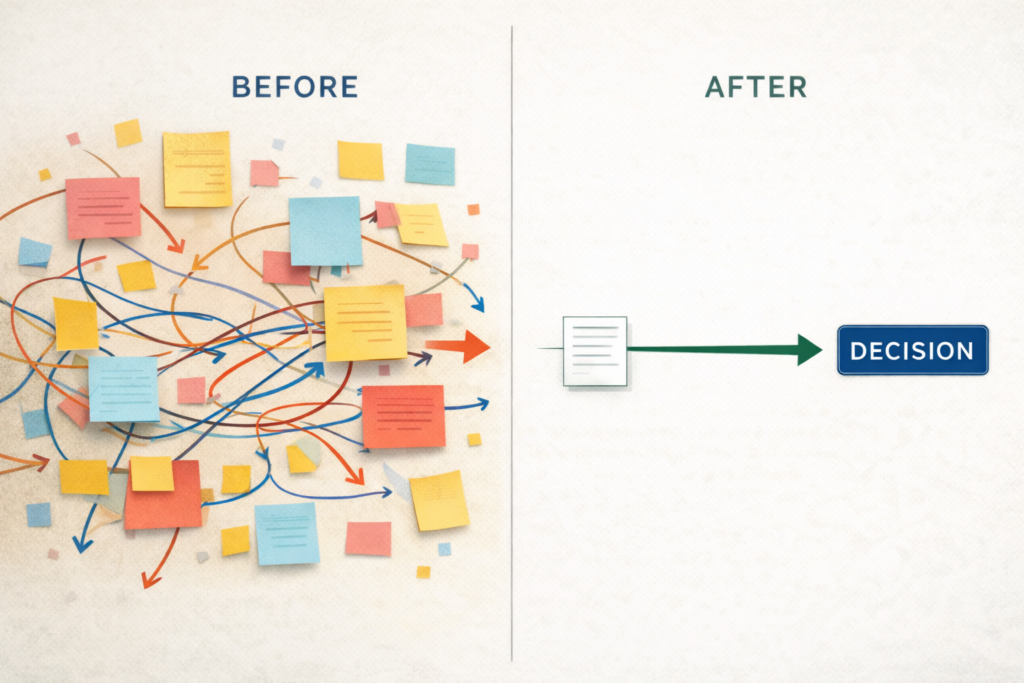
When those compressions happen, certain tasks collapse entirely. Not because AI is smarter, but because delay, handoffs, and manual interpretation no longer make sense.
Status reporting fades when systems can explain themselves. Manual QA triage loses relevance when quality is continuously enforced rather than inspected after the fact. Project estimation theater becomes unnecessary once capacity and delivery data are trustworthy in real time.
Transformation is not automation layered on top of old roles. It is the removal of friction that once justified those roles.
When that friction disappears, organizations either reclaim margin and speed or discover how much cost was being justified by inefficiency.
How Roles Evolve vs. Disappear
Roles disappear only when their purpose was task execution alone.
Business leaders increasingly frame this distinction as task versus purpose, arguing that repeatable work will be automated while accountability and judgment remain human responsibilities. Even highly AI-forward companies echo this view. (Business Insider, Harvard Business School)
Roles evolve when they are anchored to judgment, accountability, and outcomes. But judgment does not improve automatically. It requires leaders who understand what questions matter, a discipline explored more deeply in AI Literacy for Leaders: How to Ask the Right Questions.
In practice, roles shift toward prevention, judgment, and constraint design:
- Engineers spend less time updating tickets and more time preventing architectural drift
- QA spends less time catching defects and more time enforcing quality systems
- Managers spend less time collecting updates and more time making tradeoff decisions
- Operations spends less time reconciling data and more time designing constraints
AI does not replace responsibility. It sharpens it.
As tasks fall away, roles become more exposed. There is less room to hide behind activity. Less tolerance for performative work. More clarity about who owns the results, which further leads to visibility being the hidden lever for fair leadership.
This is why AI feels threatening. Not because it removes humans, but because it removes excuses.

The Real Question
The question organizations should be asking is not how many jobs AI will replace.
The real question is whether roles are designed to create value once low-value tasks are gone.
If a role cannot articulate its purpose without listing tasks, it is fragile.
If a role is accountable for outcomes, AI makes it stronger.
AI is not coming for jobs.
It is coming for everything that distracts people from doing them well.