
The Trust Leak Problem: Why AI Governance Matters More Than Ever

Most of us remember the first few times we used AI. There was hesitation. Prompts were careful. Information was withheld. We paused, wondering what was safe to share and what wasn’t.
That caution didn’t disappear because the risks were resolved. It faded because the answers started working.
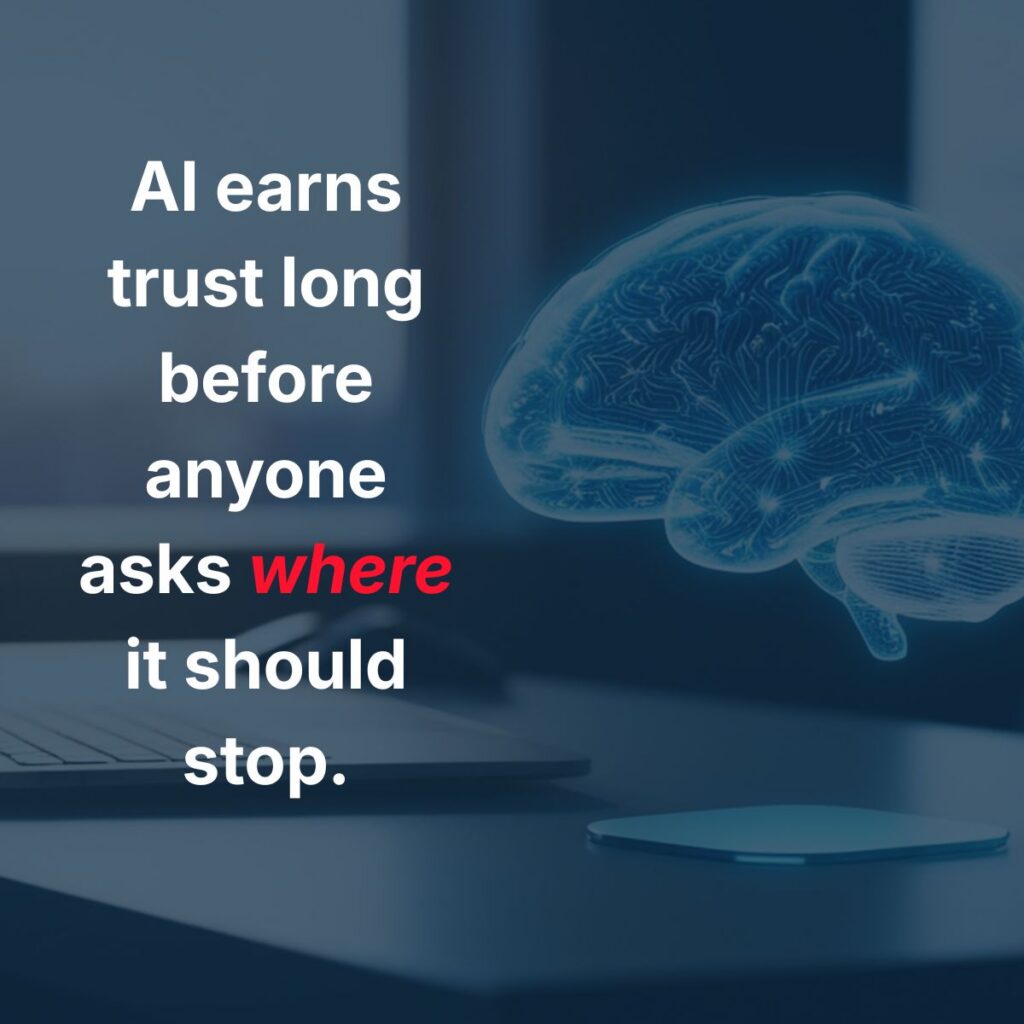
Over time, prompts needed fewer iterations. Results arrived in seconds. The friction that once encouraged discretion quietly fell away. What began as a conscious choice became a habit. This is how trust leaks. Not through a single decision, but through repetition that removes friction faster than judgment can keep up.
This shift is easy to miss. And yet, decisions about trust, disclosure, and reliance are being made faster than most people realize.
At an individual level, this feels manageable. At an organizational level, it becomes something else entirely. As explored in Customer Trust & AI Transparency, trust becomes exponentially more complex when systems scale beyond individual use.
How Trust Builds
Software engineers, analysts, and operators learn to trust output when it proves useful across a handful of interactions. When responses are fast, coherent, and repeatedly correct, skepticism fades. Verification becomes lighter.
This is not irrational behaviour. Within constrained contexts, it is often the right response. AI systems can be extremely effective when the scope is clear, inputs are controlled, and outputs are well understood.
The danger is not in trusting AI where it has earned trust. The danger is assuming that trust generalizes. AI often reveals weaknesses in oversight and process rather than creating them, a pattern examined in AI Doesn’t Solve Problems — It Reveals Them.

How Trust Leaks
Once trust is established, it tends to spread.
Confidence gained in one domain quietly carries over into others. Teams stop questioning outputs. Verification becomes sporadic. Assumptions harden into defaults. The system that was reliable here is treated as reliable there.
This is where boundaries break down.
The distinction between constrained and unconstrained use cases erodes. Context is lost. And trust begins operating without guardrails. At that point, trust is no longer an asset. It becomes a liability.
Trust leakage is what happens when confidence earned in a constrained use case quietly becomes permission in unconstrained ones.
The Real Consequences
When trust leaks, the impact is not theoretical.
Organizations begin to experience failures in areas that were never meant to be covered by implicit trust:
- Data governance breaks down as systems are given access beyond their original scope
- Security vulnerabilities emerge when outputs are accepted without verification
- Privacy breaches occur when context boundaries are crossed
- Compliance violations surface because oversight assumptions no longer hold
None of this requires malicious AI behavior. It only requires misplaced confidence.
The Profiling and Manipulation Risk
This risk becomes more acute as models grow more capable.
Emerging research suggests that modern AI systems can infer user preferences and behavioral patterns from relatively limited interaction. In some controlled experiments, relatively few prompts were sufficient to infer preferences, patterns, and behavioral tendencies.
Once profiling occurs, influence becomes possible.
This influence is rarely overt. It does not look like commands or coercion. It manifests subtly, shaping how options are framed, what trade-offs are emphasized, and which paths feel “reasonable.”
This goes beyond purchasing behavior. It touches decision-making, risk tolerance, and judgment.
In the wrong hands, this becomes a vector for manipulation. Users may be nudged toward actions that introduce vulnerabilities, expose sensitive information, or bypass controls — often without realizing they are being influenced at all.
Reframing the Threat
It is tempting to frame this as a problem of AI systems acting badly. That framing is misleading. The real threat is not self-aware AI behaving maliciously. The risk sits significantly upstream.
Entities involved in training models may have incentives misaligned with yours. Training data, reinforcement learning processes, and optimization goals can embed subtle behaviors and biases long before a model ever reaches your organization.
By the time an AI system is deployed internally, influence vectors may already be present. This is not a rogue-AI problem. It is a supply chain problem as much as a technology problem. Or stated more plainly:
“It’s not AI that causes bad things. It’s bad people using AI to cause bad things.”
Why Governance Matters More Than Ever
Because the risks are upstream and subtle, governance cannot be optional. You cannot rely on “the system seems trustworthy” as a security model. Human intuition is not designed to detect gradual trust leakage or subtle influence.
Governance, process, and oversight must be intentional.
The risk is not that teams trust AI. The risk is that no one is accountable for where that trust is allowed to operate. Trust must be bounded, contextual, and continuously reassessed. Verification cannot be ad hoc. Skepticism must be designed into workflows rather than left to individual judgment.
This is not about slowing teams down. It is about ensuring trust remains earned, scoped, and justified. Executives do not need to fear AI systems. They do need to respect how quickly trust forms and how quietly it spreads.
The organizations that succeed will be the ones that treat trust as a managed resource, not an assumption. They will invest in governance, process, and clarity before problems surface, not after.
AI can be an extraordinary accelerator. But only when trust is bounded, contextual, and governed. That is why AI governance matters more than ever.