Why SMBs Don’t Need “More Tools”- They Need Smarter Intelligence
Tool sprawl is the silent killer of productivity

Over the last decade, small and mid-sized businesses have been told the same story over and over again:
“Adopt this tool, and your problems will be solved.”
Project management software. CRM platforms. BI dashboards. Chat tools. Document repositories. Industry-specific apps. Reporting add-ons. Automation plugins.
Each one promised efficiency.
Together, they’ve created chaos.
Most SMBs aren’t under-tooled-they’re overloaded
The real problem isn’t a lack of software.
It’s a lack of intelligence connecting it all.
The hidden cost of tool sprawl
On paper, more tools should mean more capability. In reality, they introduce friction at every level of the business.
- Information lives in silos
Data is scattered across systems that don’t talk to each other. - Context gets lost
Teams know where the data is, but not how it connects or why it matters. - Decision-making slows down
Simple questions require logging into three platforms, exporting reports, and reconciling contradictions. - Adoption drops
Employees stop using tools properly-or altogether- because the cognitive load is too high. - Leaders operate on partial truth
Strategy is built on outdated, incomplete, or manually assembled information.
The result? Businesses spend more time managing tools than running the business
The real issue: Tools don’t think-people do
Most business software is excellent at storage and processing.
Very little of it is good at understanding.
Tools can:
- Track tasks
- Store documents
- Log activities
- Generate reports
But they can’t:
- Explain why something is happening
- Connect patterns across systems
- Answer nuanced, real-world questions
- Adapt to how humans actually think and work
That gap between raw data and real understanding is where SMBs struggle the most. And adding another tool doesn’t close it.

Smarter intelligence changes the equation
Instead of introducing yet another platform, forward-thinking SMBs are adopting AI as an intelligence layer that sits above their existing tools.
This kind of AI doesn’t replace systems-it connects them.
Think of it as a private business brain that:
- Ingests data from multiple sources
- Understands relationships between information
- Provides answers in plain language
- Delivers insights when and where they’re needed
Rather than asking, “Which tool has this information?”
Teams ask, “What’s the answer?”
That shift alone transforms how work gets done
From dashboards to dialogue
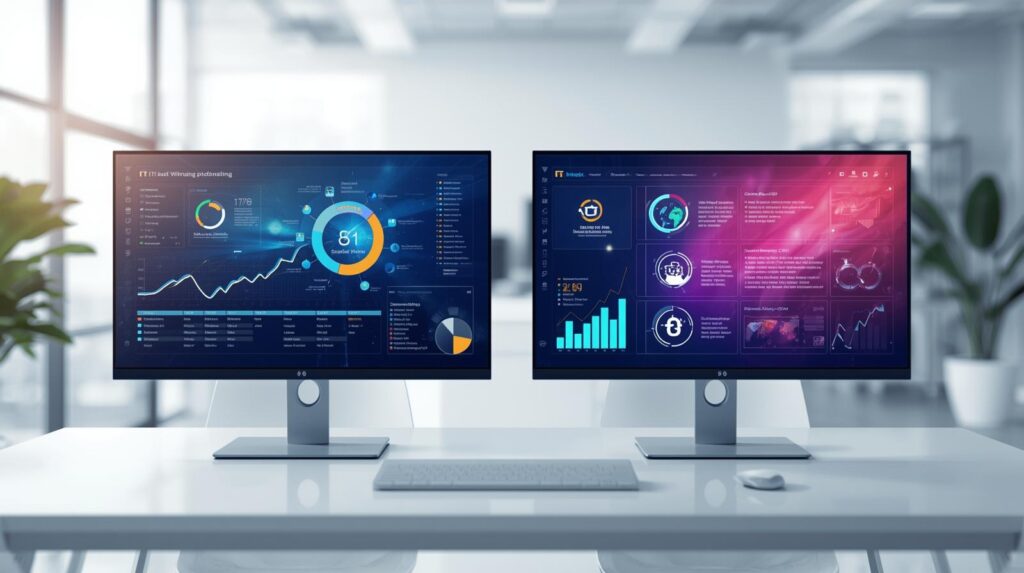
Traditional BI(business intelligence) tools rely on dashboards and static reports.
AI-driven intelligence relies on conversation.
Instead of:
- Building queries
- Running reports
- Interpreting charts
- Explaining results to others
Teams can simply ask:
- “Why did this project go over budget?”
- “What’s blocking delivery right now?”
- “Which customers are most at risk this quarter?”
- “What patterns do we keep repeating?”
The AI pulls from existing systems, connects the dots, and responds with context, not just numbers. This isn’t automation for automation’s sake.
It’s understanding at speed.
Fewer tools. More clarity.
When AI is implemented correctly, something unexpected happens:
- Tool usage becomes simpler
- Adoption improves
- Meetings become shorter
- Decisions become faster
- Accountability becomes clearer
Not because the business added more software, but because it finally has intelligence that understands the business as a whole. The goal isn’t to rip and replace systems. The goal is to make them finally work together.
The future of SMB operations isn’t bigger stacks-it’s better intelligence
SMBs don’t need another login.
They don’t need another dashboard.
They don’t need another vendor promising “efficiency.”
They need:
- Fewer assumptions
- Faster answers
- Clearer insight
- Confidence in decisions
Smarter AI delivers that, not by adding to the noise, but by cutting through it. In a world drowning in tools, intelligence is the real competitive advantage.